
Save the Right Bees
Honey Bee Awareness is a public-service education project focused on responsible honey bee stewardship, public safety, incident documentation, and the difference between gentle managed bees and highly defensive colonies.
Why This Mission Began
On April 9, 2026, our family experienced a serious honey bee attack in South Texas. The emergency involved first responders, medical and veterinary care, and the heartbreaking loss of our three dogs, Summer, Bunny, and Wingnut.
That experience became the beginning of Honey Bee Awareness—a public-safety, education, incident-documentation, and research mission created to help other families, animals, workers, responders, and communities recognize danger sooner. Start with the introduction and call to action, then follow the full story through Tammy’s firsthand account, what happened afterward, and Truth and Consequences.
Watch Introduction Watch Our Story Watch Tammy’s Story Watch The Rest of the Story Watch Truth and Consequences
Our Mission
HoneyBeeAwareness.org exists to improve public safety through education, research, and accurate incident documentation while promoting responsible stewardship of managed honey bees.
We believe people should not have to choose between protecting honey bees and protecting their families, pets, livestock, workers, or communities. Both are important.
Our mission is to help people recognize real risk, encourage responsible beekeeping, support credible research, document serious incidents accurately, and promote the preservation of gentle, manageable honey bees. Spanish safety pages are also available below. - También encontrará páginas de seguridad en español a continuación.
Core Message
Save the Right Bees.
Do Not Normalize Aggressive Bee Behavior.
Honey Bee Awareness supports responsible honey bee stewardship while helping communities recognize when highly defensive bee behavior should not be ignored, excused, or treated as normal.
Killer Bee Awareness
Many people search for “killer bees,” “Africanized bees,” “aggressive bees,” or “bee attack safety” after seeing a news story, losing an animal, or discovering dangerous bee behavior near a home, school, ranch, work site, or public area.
This search-facing page helps visitors find plain-language safety information while explaining the issue accurately: Africanized honey bees and highly defensive honey bee colonies can create serious public-safety risks when they establish near people, animals, workers, or responders.
Start Here
Begin with the introduction and call to action to understand who we are, why this mission exists, and why it matters beyond our family.
Watch the Story
Follow the story in order: why Honey Bee Awareness began, Tammy’s firsthand account, what happened afterward, and Truth and Consequences.
 Part 1
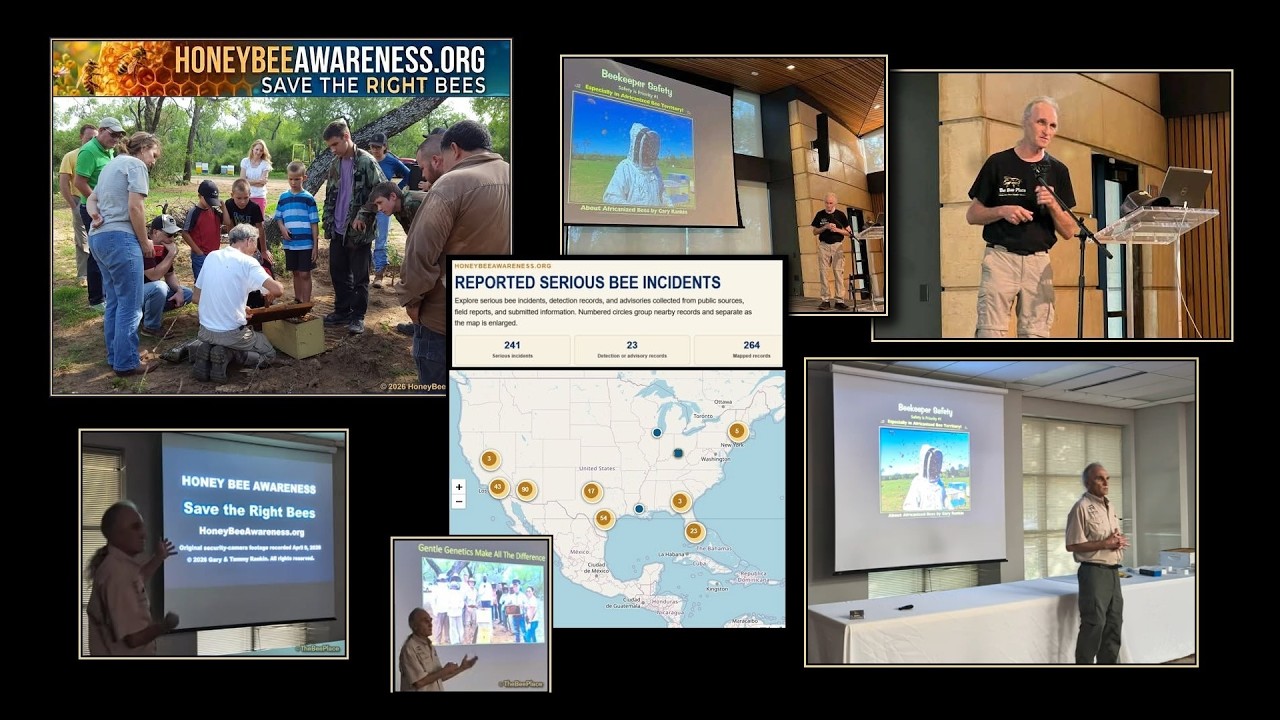
Introducing Honey Bee Awareness
Begin with the short introduction to the April 9 attack, the loss that followed, and the mission that grew from it.
Part 1
Introducing Honey Bee Awareness
Begin with the short introduction to the April 9 attack, the loss that followed, and the mission that grew from it.
 Part 2
Tammy's Story: The April 9 Bee Attack
Hear Tammy's firsthand account and watch the actual security-camera footage as the April 9 bee attack unfolded.
Part 2
Tammy's Story: The April 9 Bee Attack
Hear Tammy's firsthand account and watch the actual security-camera footage as the April 9 bee attack unfolded.
 Part 3 New
The Rest of the Story
See what happened after Tammy went to the hospital, how the colony was removed, and why the larger mission began.
Part 3 New
The Rest of the Story
See what happened after Tammy went to the hospital, how the colony was removed, and why the larger mission began.
 Part 4 New
Truth and Consequences
Watch Part Four: honey bee movement, swarming, public safety, aggressive genetics, and why this issue is bigger than beekeeping.
Part 4 New
Truth and Consequences
Watch Part Four: honey bee movement, swarming, public safety, aggressive genetics, and why this issue is bigger than beekeeping.
Explore Honey Bee Awareness
 New
Killer Bee Awareness
A search-facing guide for people looking for information about killer bees, Africanized bees, aggressive bee behavior, bee attacks, and public safety.
Outdoor Worker Safety
Guidance for mowing crews, landscapers, tree trimmers, utility workers, ranch hands, farm workers, and responders.
Types of Bees
A plain-language guide to managed honey bees, feral colonies, Africanized honey bees, and why genetics matter.
About Africanized Bees
Learn why behavior, colony genetics, queen mating, and unmanaged colonies matter for public safety.
Research
Explore HBA documentation priorities, field observations, research boundaries, collaboration opportunities, and long-term questions.
Incident Database Methodology
Learn how HBA sources, reviews, classifies, and labels incident records, source strength, bee identification, and data limitations.
New
Killer Bee Awareness
A search-facing guide for people looking for information about killer bees, Africanized bees, aggressive bee behavior, bee attacks, and public safety.
Outdoor Worker Safety
Guidance for mowing crews, landscapers, tree trimmers, utility workers, ranch hands, farm workers, and responders.
Types of Bees
A plain-language guide to managed honey bees, feral colonies, Africanized honey bees, and why genetics matter.
About Africanized Bees
Learn why behavior, colony genetics, queen mating, and unmanaged colonies matter for public safety.
Research
Explore HBA documentation priorities, field observations, research boundaries, collaboration opportunities, and long-term questions.
Incident Database Methodology
Learn how HBA sources, reviews, classifies, and labels incident records, source strength, bee identification, and data limitations.
 Do Aggressive Bees Make More Honey?
Examine the research behind a common claim and why aggressive temperament is not proof of greater honey production.
New
Research Goals
Learn about the long-term questions HoneyBeeAwareness.org hopes credible research can help answer.
New
Trusted Research & Education Resources
Explore carefully selected researchers, universities, public agencies, and educational organizations.
Do Aggressive Bees Make More Honey?
Examine the research behind a common claim and why aggressive temperament is not proof of greater honey production.
New
Research Goals
Learn about the long-term questions HoneyBeeAwareness.org hopes credible research can help answer.
New
Trusted Research & Education Resources
Explore carefully selected researchers, universities, public agencies, and educational organizations.
Start Here
New visitors can begin with Start Here, Killer Bee Awareness, Types of Bees, then continue to About Africanized Bees, the Safety Guide, or the Incident List.
Outdoor crews and first responders should also review Outdoor Worker Safety.
If you witnessed or documented a serious bee incident, please use the Submit an Incident page.
Spanish Safety Pages / Páginas de seguridad en español
Spanish safety pages are being added in stages so this information can reach more families, workers, property owners, and communities in regions where highly defensive bees may be present.
Some pages are already available in Spanish, including Safety Guide in Spanish, What To Do During a Bee Attack in Spanish, and Outdoor Worker Safety in Spanish.
Additional Spanish versions are in progress. Please check back as the Spanish section continues to grow.
Las páginas de seguridad en español se están agregando por etapas para que esta información pueda llegar a más familias, trabajadores, dueños de propiedades y comunidades en regiones donde puede haber abejas altamente defensivas.
Algunas páginas ya están disponibles en español, incluyendo Guía de seguridad en español, Qué hacer durante un ataque de abejas, y Seguridad para trabajadores al aire libre.
Hay versiones adicionales en español en desarrollo. Por favor vuelva a revisar pronto mientras la sección en español continúa creciendo.
How You Can Help
HoneyBeeAwareness.org is being built as a public-safety education and research resource. Researchers, Extension specialists, emergency responders, veterinarians, outdoor workers, beekeepers, property owners, and people with direct knowledge of incidents can help by sharing credible sources, incident leads, field observations, and practical safety lessons.
For research collaboration, source corrections, or general project questions, please use the Contact page.